Despite having graduated from UIUC a couple of years ago, I get lots of questions about graduating from UIUC CS in 3 years. This post combines advice I’ve given to many people and seen them implement.
While 3 years sounds very accelerated, it’s totally possible for most people with the right planning. I also don’t think it’s the right idea for most people, though there are good reasons to do it. Fundamentally, you have to be clear on what this degree means to you and how it plays into your life goals.
Warning: I’m not your advisor and not a replacement for one. Please meet with them before every single semester with your entire plan and be upfront about your goals. A lot of people think advisors aren’t friendly to 3-year plans, but they were fantastic with mine and helped me reshuffle it so it was more realistic. If you seem uncertain, they’ll guide you toward a risk-averse path, which is the right answer for most people, but showing preparedness and determination can get you strong support. That being said, feel free to email/DM me with your plan and I’ll try to give feedback.
Note: The info here is accurate at time of writing. CS requirements will keep evolving, but the mindset will stay largely the same. Feel free to reach out or make a pull request if you’d like to update any information.
Figure Out Your Overall Goal
When people talk about UIUC in 3 years, it can mean very different things.
6 Semesters
Typically this is what most people mean: 6 full-price Fall & Spring semesters. These happen over 3 calendar years, though many people space them out with internships, study abroad, or gap semesters.
I suggest this if you’re optimizing on
- money spent less on education
- time spent in class
- more room for internships than the 3-5 summers normally available
3 Calendar Years with Summer Semesters
Adding summer classes can get you to 7–8 semesters while still finishing in 3 calendar years, with a more spread out workload closer to a typical 4-year pace.
This has many of the same advantages as the 6 semester plan, but with more breathing room. I’d suggest this to those optimizing for
- less years spent as a student
- having a gap year or similar
Consider 7 semesters
While 6 semesters is a little tight, 7 gives far more breathing room and can still save money. Your 7th semester can also be a part-time semester, which is cheaper, and this allows a longer college experience, one more summer break/internship, and often a longer gap between graduation and a job start. UIUC will still let you do the May graduation ceremony even if you graduate in December.
Note for OPT: Graduating in December reduces the lottery attempts from 4 to 3 for the duration of an OPT. It might seem small from afar, but I’ve seen people really regret this.
Plan
Start planning early, ideally before your first semester. This needs coordination around proficiency tests, degree requirements, and paperwork. You can still start later in your degree, but the later you do, the more stressful it gets. Make a worksheet of what every semester will include, with clearly defined classes or class groups, to ensure the whole plan works. The UIUC Course Explorer is useful for checking prerequisites and seeing what’s available.
Understand the CS and Math Main Sequence Really Well
The main thing to keep in mind is making progress on the core CS sequence as quickly as possible. CS 225 unlocks a lot of elective chains at once, so getting there early helps a lot. Use your degree page to map out your exact sequence, but for most CS majors the common part looks like this DAG:
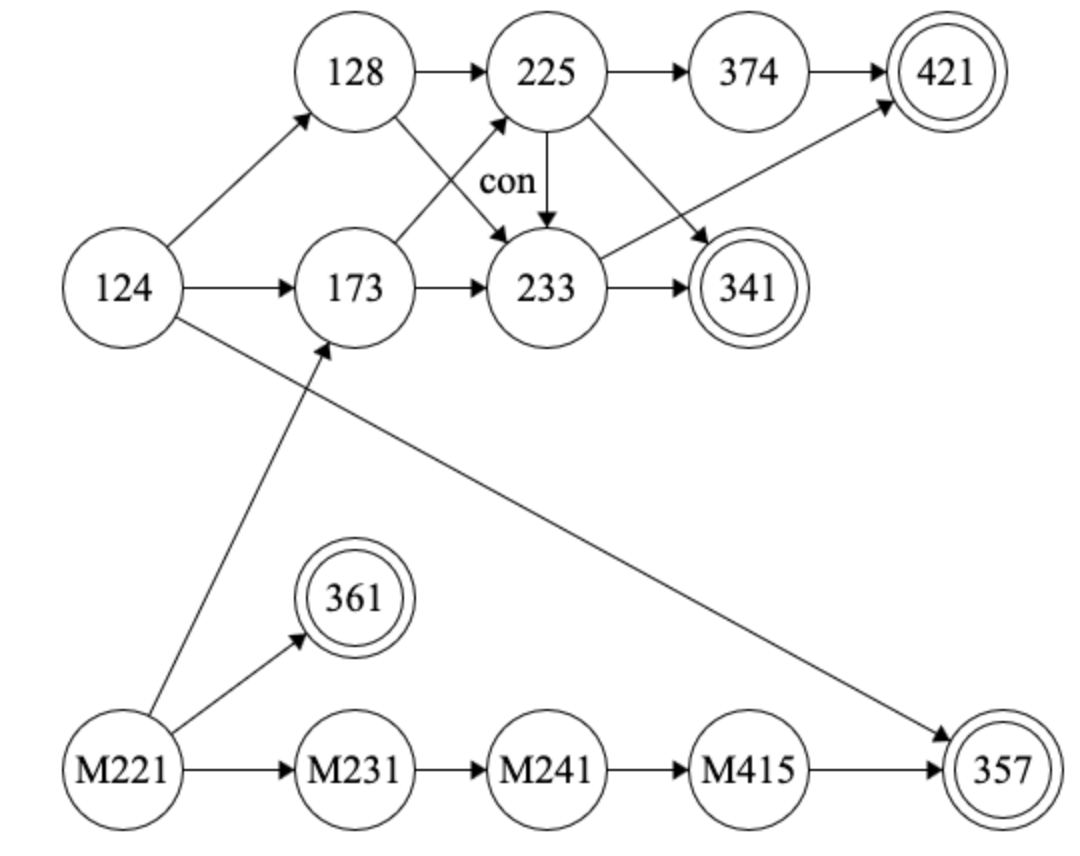
Note: This image is made using Evan Wallace’s Finite State Machine Designer that you’ll definitely see in many of your UIUC classes.
- I’m using double circles to indicate the terminal class in each required sequence
- CS classes are indicated with no number, and I’m using
Mto indicate Math classes - ‘con’ stands for concurrent. This means you can take the next class in the sequence if you’re already taking that one. Here there is CS225+233 and MATH257+CS361. I highly suggest both to shorten your chain.
The longest chain is length 5 in both Math and Computer Science, so ensure that you’re making strong progress toward each. This strictly forms the lower bound of how quickly you can graduate. If your goal is 6 semesters, this means you only get a single semester where you’re not progressing on the longest chain, and I recommend having that one semester be the last one for slack. Later I’ll talk about proficiency tests, which can shorten the main sequence and get you to electives quicker.
While the Math sequence chain is 4, quite a few people come in with credit for Calc 1 (such as IB) and even credit for Calc 2 (APs, college courses), so they start further along. Unless you went to a narrow slice of elite American and international schools, you’ll usually start around the beginning. I suggest first trying to get through the placement/proficiency tests so you can start as far as possible to at least get past calc 1 and ideally 2. Some of the newer CS + X majors vary in how far you need to go in this sequence, but I personally think every CS major should understand multivariate calc and linear algebra and strongly suggest taking them anyway unless it really gets in the way of your graduation plans. I’ve used concepts from these a lot in later classes and they’ve come up in my job as well.
In the past, prereqs weren’t as strictly enforced, so some of the older advice you will get may not apply, but often it’s still possible if you ask nicely and acknowledge to advisors, professors, and the department that this might blow up in your face. This is usually easier after your first semester since you can point to your strong academic record so far. I had a roommate who took CS 233, 374, and 421 at the same time for their third semester, and did CS 225 alongside 126 (precursor to 128) during the second semester. I don’t recommend relying on this, but it can certainly help. Having overrides on prereqs worked well for me when I was signing up for grad classes since their enforcement is less strict and professors have far more leeway.
Some of these classes also have math requirements, so keep that chain moving too. I have seen some first-years take CS 357 and 361, though slot them in when it makes sense for your plan. This depends on which electives you’re more interested in. For example, I took CS 341 because wanted exposure to C and systems-level stuff for my electives, and I took CS 357 early since it aligned with my Statistics classes. I wasn’t as interested in the programming language side, so I put CS 421 toward my senior year. I had a passing interest in functional programming, but not enough to go much deeper than type inference and lex+yacc.
If you’re not sure where your interests lie, frontload core classes to ensure more optionality later.
CS College of Engineering - Account For Electives
If you’re in CS in the College of Engineering, you’ll have 8 electives: 6 have to be within CS, and 2 can be outside. For most people I’d still suggest doing all CS anyway, but go based on your interests and your semester’s overall difficulty. As soon as you’re able to, generally in your second year, start loading up on electives as they unlock. Assuming you finish CS 225+233 by the end of your third semester, you’ll have to take 3 electives for 2 more semesters and 2 electives for one semester. Not all electives are equal in difficulty, so definitely keep this in mind as you slot things in.
CS (+|&) X - Frontload your X Classes
There are quite a few of these majors, so I’m generalizing here, but almost all of them function kind of like a minor and don’t require many electives beyond fulfilling a handful of groups. The X portion of your major likely also has a main sequence that’s 4-5 classes long, so you should be moving that along almost every semester too. For example, I was in CS and Statistics, so I was also pushing along my Statistics main sequence, which definitely made the earlier parts of college core class heavy. If you need to, move more of the general education requirements towards the end of the degree.
CS (+|&) X - Consider CS 233 + CS 341 over CS 340 + Two electives
Not all, but many of these majors let you opt out of CS 233 (Computer Architecture) and CS 341 (Systems Programming) in favor of CS 340 (Introduction to Computer Systems) plus two 400-level electives. I strongly recommend doing CS 233+CS 341 anyway:
- The GPA risk is overstated: The low averages that gave last decade’s CS 241 its reputation have largely disappeared in today’s CS 341, and CS 233 runs higher than CS 231 did.
- It’s not actually faster: Taking CS 225+CS 233 and then CS 341 in the next is two semesters. Taking CS 225 and then CS 340 still takes the two semesters, and most good electives only unlock after 225 so you’ll be taking them along CS 340.
- The material builds an important foundation for your later education and career: Processor internals, assembly, systems programming, network primitives, latency/throughput tradeoffs, cache optimization, parallel programming, and so much more. The CS 340 syllabus itself notes the gap clearly:
CS 233 and CS 341 invest 8 credit hours in going into detail on topics that CS 340 covers in 2 credit hours. Our briefer overview is sufficient for many purposes, but leaves out details needed for hardware-aware application domains such as embedded systems and cybersecurity.
That said, read the 2020 topic comparison, the CS 341 syllabus, and the CS 233 learning goals to decide what’s right for your goals.
General Education Requirements
Graduating in 3 years means making tradeoffs, and this will often be at the expense of the broad liberal arts education UIUC is known for. Those classes are genuinely great, and it’s hard to get this kind of educational opportunity later in life, but taking high-effort gen ed classes will make 3 years more daunting. There are many UIUC classes that can count toward two or even three requirements, as well as some eight-week online forum-post style classes that are very little work.
Similar to the earlier sequences, the students who went to the right schools (tm) will have quite a few of these requirements already fulfilled, but it’s still quite doable. Proficiency tests still help here for things you do have prior knowledge of.
Many students have the same idea, and these classes can book out quickly, so don’t have too rigid a plan for exactly when you’ll finish each requirement, as long as you’re moving along on gen eds. As you progress later in your degree, you’ll be able to register earlier, and being in the honors program also helps.
In terms of scheduling, I suggest pushing this later in your degree because I think it’s more important to hit your core degree requirements upfront, especially for CS&X/CS+X, but this can be fairly flexible. If you do have a language requirement I think it’s fine to do towards the end because it doesn’t unlock anything too meaningful.
Personally I enjoyed my higher-effort comp lit classes a lot, and getting to survey new fields like linguistics, disability studies, and horticulture was great. Despite the tight timeline, you can still take many interesting gen eds, but this will always come at a cost and this is tragically a luxury.
Winter Classes
There are also winter classes, but it’s a very short break and these typically just get gen eds out of the way, which I don’t think is better than doing it in a normal semester, especially with double/triple-counted and 8-week classes available. Still, it can work well for you if there wasn’t much opportunity to overload on gen eds so far, like after your very first semester.
That being said, a student schedule can be intense and having a high-quality break of a few weeks goes a long way. I honestly liked using winters as a true guilt-free break of doing nothing and spending time with family to recharge for the next year. I also came from a part of the world with very standard daylight, so this helped me recover from the seasonal depression a bit.
Understand The Relative Difficulty of Classes To Balance A Semester
While planning, you should have a solid idea of each semester’s difficulty because you don’t want to accidentally burn yourself out. This is a marathon, not a sprint, and having the right pacing throughout is key. For the ~5-6 real classes you’re taking each semester, aim for two hard, three medium, and one easy class. Depending on your planning, you might end up with a semester where you have three hards which you’ll have to power through.
Figuring out which class falls into which bucket isn’t easy. I like to approach this along these axes:
- how much work a class has: homework, midterms, quizzes, MPs, team projects, readings
- how intellectually challenging a class is
- how do students typically perform
- past background in the class
- how interesting you find the class
For example CS 374 didn’t take much work per week and only had 3 exams, but it was definitely a lot of thinking each week to arrive at optimal solutions, while CS 341 wasn’t as challenging but it needed discipline as it was a lot of work each week in terms of homework with very careful debugging.
What’s easy for you might be hard for others, and you might find yourself getting humbled by a class most students consider quite easy, but generally averages across a large sample hold, so I recommend understanding data.
GPA
The first piece of data you should understand is the GPA averages for the class:
- GPA++ - enter a class, class level or just filter by category (e.g.
CS 4) to see gpa history by professor - developed alongside my uiuc roommates - waf.cs GPA visualizations many different great data visualizations - developed in the group led by Professor Wade Fagen-Ulmschneider
As someone who loves education and learning, it feels bad to talk about optimizing classes around GPA. I don’t think the point of an education is taking the easiest possible classes to get a piece of paper, but I’m also someone who overplayed my hand in the past and got burned. There’s a nuanced middle ground between optimizing for GPA and actually learning a lot.
Past Student Reviews
The second piece of data is more subjective, since it’s mostly from disgruntled students who can be very unreliable narrators, and it has all sorts of demographic and difficulty bias mixed in. Still, I think it’s useful for things like workload or course structure that GPA data can’t capture. Usually I’d look on:
- RateMyProfessors - Has basically every American university on it, but the data quality is really bad.
- r/uiuc - and similar subreddits have gossip on various classes and professors. It’s a little better than RMP but not a lot better.
Also filter by class since the same professor can vary a lot across courses, but trends like teaching quality or friendliness do hold. If an instructor is new to UIUC, you can often find online gossip from their previous university too.
UIUC also collects internal teacher evaluations called ICES, with far better completion rates and less bias toward upset students, but these are only accessible within the department. I do wish it were public since it is much better than the places I’ve linked, and there’s a good r/uiuc discussion about this. It still suffers from a lot of the same biases I mention though.
Public Teaching Material
UIUC CS has a great culture of just publishing teaching material on the open internet, which is great for learners outside UIUC, but also students who aren’t in the class yet. In breaks before term started, I’d often just watch lectures from a past semester, read their slide materials as a broad first pass. Depending on your experience learning the material, it’s a decent way to gauge how hard a class might be, but I’m putting it lower in my recommendations because it’s really hard to judge without having access to the homework and exams. As a side bonus, doing this will often make the classes easier since people learn better with multiple passes.
Credit Fillers
Quite a lot of people have a large amount of pre-existing college credit coming into college, to the point where “sophomore by credit hours” is a running joke. While many of these credits are quite useless in terms of getting to advanced classes earlier, it does save the effort of having to fluff up credit hours to graduate in 3. Not having this means taking ~21 credits each semester which is quite a lot, and assuming you don’t overload the first semester and take 18, this leaves 22 credits overload for every single remaining semester. Actually having that kind of load with a realistic class schedule is going to be too much for most people, so you should strongly consider taking credit hours that require virtually no work just to check this box.
There are many options here:
- at the start of your degree there might be some orientation/job training classes that take little work. For example, I had optional LAS 100 - College Success for International Students that gave 2 credit hours and CS 199 - Course Assistant Training for 1 hour.
- many electives have a 4 credit grad version, and 3 credit undergrad version. The difference in workload isn’t too large for most classes, so I suggest doing the grad version in those scenarios. While it’s only one extra credit at a time, these do add up. As a side bonus you do learn more and can even double count it toward a UIUC Master’s.
- 8 week online-only classes where it’s practically just writing short discussion posts. I ended up learning a bit more than I anticipated and some of the readings were great, but these are definitely not at the level of a standard college class.
- trying some activity-based classes like walking or vegetable gardening. Some can be deceptive though, 1 credit Ice Skating was my hardest class I’ve ever tried in my life, I regularly went to so many office hours and extra skate sessions and still ended up dropping out because I was so behind.
- CS 397/497/499 research credit. This can be a lot of work so your experience may vary, but I found it quite interesting and it didn’t really feel like work at all. I did this almost every single semester and nearly hit the departmental maximum.
- community college classes at places like Parkland which can be far less work, though this will cost extra money
If someone doesn’t have a strong starting point in terms of the CS or Math sequence, it makes sense to be hesitant about a three year plan, but I don’t think anyone should decide against the three year plan because of the overall credit hour requirement.
Proficiency & Placement Tests
The CS & Math main sequence chain length of 5 is the main thing to tackle, and the best way is starting further along in the sequence. Many of you will have Math credit already, but UIUC doesn’t recognize high school AP/IB Computer Science for the intro course, so that’s the first one to consider testing out of, then see what else you can. Getting MATH 220/221 and CS 124 out of the way leaves a chain length of 4 to cover in 3 years, which is far more doable.
proficiency.cs.illinois.edu is a great website with detailed information on the exams, and you can take the first four main sequence classes: CS 124, CS 173, CS 128, CS 225.
The Math department lists out their proficiency tests here which I suggest reading. Similar to CS, you can go quite far in the core sequence: MATH 220, MATH 231, MATH 241, MATH 257.
Someone being able to do all of these is quite rare, but people can often get surprisingly far. These are free, so I suggest trying them anyway. My suggestion is to target CS 124, CS 173, and one math test from wherever you’re starting. Doing more than that is a lot to prep for over the summer. If this is winter, only target one test.
The right time for these tests is usually before your first semester begins, which means summer for most people. It does get in the way of that peaceful break between high school and college, but having entire semesters of a headstart is worth it. There’s also a window to do these right before the second semester and before the start of the summer term, but after that it is not worth thinking about much later since these only cover early-sequence classes.
If you don’t prof out of these classes, your first semester will be lighter on major classes, which is a good time to frontload gen eds and keep the 3-year plan going.
CS 124
If you did high school CS or self-taught growing up, this is likely the right test for you. Brush up on Java and object-oriented programming basics first. Complete CS 124’s public online version with daily homework at learncs.online. There’s also CS 199: Even More Practice, review slides and 3 problems per slideshow written by me and a few other CS 125 Course Staff.
If you find this taking longer than 2 weeks or don’t really have any CS experience, I strongly suggest taking the class instead. Having the right CS foundation will pay dividends for the rest of your college life and future career. It will make the 3 year plan harder, so also consider if you really want to do the degree faster since having a better education is worthwhile.
Personally I did CS 124 anyway, though more out of a feeling of misplaced imposter syndrome, and I loved the class enormously. I went on to be part of its course staff for nearly my entire college life, won an outstanding course assistant award, made most of my college friends across several years from there, and got to spend a lot of time thinking about the near future of CS education. At the time of writing the course assistant CS page still has me in the main picture to advertise the position.
CS 173
If you have learned introductory logic, set theory, or basic proofs, I suggest the CS 173 proficiency test too. Start by reading Professor Margaret Fleck’s amazing textbook Building Blocks for Theoretical Computer Science. It’s one I kept going back to years after the class — it doesn’t assume much background and covers the core concepts really well, so definitely familiarize yourself with it. After that, look at the CS173 Official Study Material, especially the past examlets.
If you find yourself not sailing through all of it, like I did, just take the class. Personally I was good with about half of the material but lacking on the rest, and I gained a lot from taking the class which helped me do well in CS 374 later and excel in my new grad interviews.
Calc Tests
I suggest only doing tests at a level of math you’ve already learned, but for review, check out Paul’s Online Notes for Calc I+II+III. I used them a lot as a student, and they’re very well written. I also liked Khan Academy’s videos, and they have plenty of practice problems too. Often when I was stuck, I used Wolfram Alpha’s Solver (led by UIUC CS Professor Stephen Wolfram) to cross-check while practicing.
My own high school credit started me at Calc II so I wasn’t too worried about it, but in hindsight I should have been starting in Calc III just to be faster.
ALEKS Placement Test
UIUC has students take the ALEKS PPL Mathematics Assessment Exam when starting out to figure out whether to begin with Calc I or earlier. I didn’t prep at all for this since calc was very fresh for me, but I suggest doing a bit of review beforehand. If you don’t get placed into Calc I, I highly suggest taking the time to build the right math foundation in your coursework and avoiding calc proficiency tests for now.
Understanding UIUC’s Cost
The main reason I saw people do a shorter time is cost, and it’s important to understand what your cost will be so you can make the right tradeoffs. A guide to fully optimizing your cost at UIUC is beyond the scope of this page and there’s a lot written on this online, but I think it’s important to understand it broadly as it relates to how your degree plan will go.
Typical Semesters
- There’s a three tier structure for tuition, with in state students at the cheapest rate, around double for out of state and slightly higher for international students.
- UIUC has a fixed tuition cost for four years of your degree. This eliminates the biggest source of variance to worry about.
- Fall and Spring Semesters don’t charge by credit hour.
- ≥12 credits (full time) - no price increase for going beyond.
- 6-11.99 credits - 2-3 typical classes
- 1-5.99 credits - 1-2 classes
The best price ratio is still with overloaded semesters, but if you can make your last semester part time, that will also save thousands of dollars. However, also consider replacing that partial semester with cheaper rates in the Summer or Winters.
Overloaded Semesters Due To Fixed Cost
Unlike many other universities, UIUC is a fixed cost once you cross 12 credits (full-time semester), which means that you should think about sustainably overloading (>18 credits) when possible because there’s no extra cost here. I crossed it for many of my semesters for this reason since you’re getting more for the same price. If any of your semesters are part-time, the tradeoffs are really different, but for a 3-year plan you’re likely taking full-time semesters. If you have lots of incoming credit as you enter UIUC, you probably won’t actually need to overload.
I don’t recommend overloading your very first semester since university is already a huge change, and living in a new city (and often country) where everything is different. Advisors will usually try to stop you as well.
Summer Tuition
While it is per credit hour and still followed the three tier structure, the cost is around half of typical tuition, so it can still win if the alternative is extra fall/spring semesters. Most students aiming to reduce costs will live in off-campus apartments, which usually run on yearly leases, so there’s no extra marginal housing cost in that case, especially since the supply of summer sublets is much higher than demand.
With summer you have to remember that most courses are compressed to 8 weeks so it’s actually twice as fast. If you want to recharge between semesters, are doing research, are interning somewhere I suggest only taking a single class. If you’re fine with the intensity of a normal semester, take two classes. Taking more than that can be challenging so I don’t suggest it.
If you just finished living in the dorms, summer sublets can also be really cheap if you look carefully. I did not look carefully, trusted the wrong person, and had multiple break-ins which contributed to a campus massmail, which accidentally cost thousands in ‘rent’.
Housing And Related Expenses
The other large cost in UIUC is housing, especially with the mandatory overpriced one year requirement that acts as a quasi-tuition that many aid/scholarships don’t adequately cover. Urbana and Champaign are relatively affordable places to live with quite a lot of midrise dense housing that’s connected to public transit, so after your first year the market rate living you can get will be much cheaper and you’ll likely have far more space over the dorms at a fraction of the price.
In the past, I’ve not seen the university grant exceptions due to financial hardship, medical disabilities, and even people who spent the first year doing remote university were forced into the sophomore year dorms. There are exceptions for a few rare cases, but don’t count on it.
First read the pricing pages for the dorms, even the cheapest quad sharing room cost twice what having my own room in a market rate apartment literally next to campus near the CS building cost. I suggest taking the cheapest meal plan (12+15), and a double or triple since it’s barely more expensive than a quad. If you get lucky, there’s another UIUC scheme called Private Certified Housing which has some cheaper rates, but these have limited capacity and go out very quickly. Some are religiously affiliated so keep that in mind.
The general tradeoff you need to keep in mind is that almost all market leases will include the summer and winter, you can avoid this slightly with sublets, but that means a constantly shifting living situation. This instability can affect your academic productivity, so definitely be careful about this. Market rate apartments can get quite cheap, so it’s still fine if you’re paying for the breaks.
Housing is the second biggest expense after tuition, so having one less calendar year on campus will literally save a lot.
Aid And Scholarships
Despite aid/scholarship often not being adequate, most instate and some out of state students qualify for more than they realize. It’s really worthwhile to dig into these to reduce the sticker shock. I’m listing a few I’m aware of, but there are many more that are just very poorly documented.
- Illinois Commitment - Families with under $75K in assets and income (at the time of writing) get 4 years of tuition covered. Note this doesn’t guarantee dorms.
- Office Of Financial Aid - If you can submit FAFSA in time, there’s more than many expect.
- Illinois Scholarships Main Page - Listing many scholarships at university and college levels
- UIUC Merit-Based Scholarships - List of many scholarships. The university also automatically considers many people when applying
- UIUC CS Awards - Many CS department specific ones that are smaller but still worthwhile
During the Degree
With the planning done and a good starting point through tests, now comes actually following through. How to do your degree well is a huge topic and out of scope for this post, and I’ll leave some helpful links at the end. More specific to the three-year plan, every semester make sure to:
- track your degree progress against your overall plan - I did this with Google Sheets, but use whatever tool fits best for you. With every semester, things become more solidified and you can reshuffle as needed as long as you’re still good on the overall plan and main sequence. I also kept 3-year and 4-year variants of my plan, and you should plan branches accordingly.
- right before and after you register for classes, run a DARS Audit to ensure your academic plan is actually working
- go to your advisor every single semester with your plan and audit so far and the classes for the remaining semesters to get their thoughts
- do well in your classes, learn, and have fun!
Caveats
There are some important caveats of following the 3 year plan you should keep in mind. Besides my points below, also read these:
- a great r/uiuc thread
- Angela Zhang’s reflection on finishing MIT CS in 3 years
- The Daily Pennsylvanian’s Why some Penn students decide to graduate in three years
Opportunity Costs
Many students arrive with a scarcity mindset since school was a far more limited environment. College has an abundance of classes, clubs, and research to explore. 3 years is still perfectly doable while having a lot of fun side questing, but keep in mind you’ll get to do a lot less than most of your peers who are spending 4 years. While there’s so much opportunity, your true scarcity is having a shorter timeframe and you should take extra care in what you take on.
If you start taking on too much, the opportunity cost can be your three-year plan. I actually ended up in that situation: I wanted to do lots of fun extra classes, do research and teaching almost every semester, have a really busy social life, and go deeper into an area of study that has excited me almost all my life, so I abandoned my plan toward the end of my second year. Part of my motivation towards four was also COVID-19 taking away the in-person campus experience I enjoyed so much, so ironically I ended up spending 3 years on campus anyway.
Less Internship Time
Besides being fantastic learning opportunities, internships are also a prime hiring pipeline through return offers. Graduating early can mean fewer chances of return offers, though keep in mind internships before your final year don’t give full time return offers and just return for another internship. So you can actually have the same number of internships eligible for full-time return offers. Due to increased flexibility from having an accelerated timespan, I saw many friends add fall/spring co-op around their summer internship during their final year to vastly increase their odds for full-time return offers.
Shorter Rose Colored College Campus Life
College is more than classes and setting up a career. It is an incredible and unique time for fun, friends, parties, events, exploring whimsies, clubs, growing up, greek life, geek life, learning new skills, trying the great food scene, or even just spending time between classes doing nothing. With such a large student body, incredibly vibrant college towns, and so many things to do, there’s something about this life that will never come back again.
A busier and shorter life on campus will take away from this and it is something that can weigh quite a lot as the years go by. I really wish everyone can experience this, but it’s unfortunate that financial reality makes this a luxury for most people. Three years is still plenty though, and if you play things right around the start of your degree, you will still get quite a lot of the fun parts of college. It might also force you to be decisive about not wasting your time on things that don’t spark joy or bring you anything.
Spend a while reflecting on what this means for you. I really liked the TV miniseries Tatami Galaxy, which explores a student in 10 different parallel timelines all starting from a different club picked during an equivalent of quad day and the joy, sorrow, anguish, and growth that represents in his goal to achieve a Rose Colored College Campus Life.
Bad Reasons
Only do this plan if you have a good reason. College is designed around a 4-year cycle and the minimum degree requirements are intentionally light. If you can get the full college experience, I highly recommend it, but circumstances really vary and privilege absolutely applies. I think almost all reasons to graduate early are valid, but here are a few I’d caution against:
Peer group
If your main motivation is seeing your friends do it and wanting to do it too, I’d suggest against that, since their circumstances might not match yours and it might be driven by pointless competitiveness. As time goes on, a lot of that peer group might end up doing 7 or 8 semesters, which is far more doable, and then you’d have taken on extra stress for nothing. It is nice to take classes in sync with your peer group, so I suggest doing that and piling on extra things once they wrap up. Many of my friends who did three ended up living on campus for a fourth year as well, so many friends might still be around.
Personal Challenge
I am always in support of people taking on a harder pathway, but a 4-year plan with more challenging classes, research, internships, and teaching is a far better personal challenge to grow. You can follow pretty much all of the above advice and just use the extra breathing room to go further in your interests. It’s really hard to get this kind of environment after undergrad.
Good Reasons
I think the primary reason to think about this is cost, but I saw many other good reasons too:
Sticker Price
Despite being a state university, UIUC isn’t cheap, especially if you’re out of state and international.
If you’re fortunate enough to afford four years, I highly recommend it. I was extremely lucky, and that’s what enabled me to take four years. Doing so much HCI research, taking several grad level classes, having a very broad general education, near daily social plans, getting to be part of teaching almost every semester and summer, going on endless sidequests and meeting my long term life partner happened because I had the luxury to fill it out. These were the best years of my life till that point, and I am so sentimental about my time at UIUC.
I think it’s wild that tax funded universities with free land in a dedicated college town that doesn’t even pay the staff that well can still cost so much. Unfortunately, that is the reality of today and college debt is a burden that can really drag, even in a field with very high salaries like Computer Science.
Industry Opportunity Cost
Related to the idea of a price tag, the financial opportunity cost of an entire year of salary is something people should acknowledge. For many people who are doing a three-year plan, their new grad salaries can be $150k-$250k and I’ve seen a few offers like $500k. I don’t know if these kinds of offers will last long term, but at present there is a sizable sum of money that people are walking away from. In a long career of 40-50 years and compounded growth, it might not amount to a large portion of overall net worth, but it is a lot of money nevertheless. This one year’s pay can become a large part of adequate retirement savings depending on the circumstances of retirement.
Doing A Combined Masters
I knew many people who did a 3+1 BS+MS program, which let them graduate at the same time as their typical cohort, have the same number of internships, and walk out with a nicer degree. While most CS-related jobs no longer have a huge boost for doing a master’s like in the past, it’s still a sizable bump in few cases, and not having to take a career break for one is really nice. Access to classes is quite similar to undergrad, but getting a whole extra degree for one more year of CS classes is nice. As many CS degrees don’t have an explicit 3+1 program, you can just apply for a master’s to start right after. Generally most good students will get in through home-field bias and internal connections.
This can actually work out cheaper than a normal 4-year degree too, because grad-school teaching and research positions often come with tuition waivers and stipends, while the undergrad equivalents barely hit minimum wage and don’t offer as many hours. Many people I know got to experience 4 years at UIUC more cheaply because of this, though it’d be nice if undergrads were given the same level of waivers like some universities do.
Note for OPT: doing a combined program for 4 years will skip the 3 years of undergrad OPT (1 year normal + 2 years STEM), which means less time in industry and fewer lottery attempts if that is your goal. If you’re targeting academia this is fine.
Starting Grad School Earlier
As an undergrad, UIUC enables you to get a grad student-like experience with teaching, research, grants, publishing and upper div classes, but becoming a graduate student earlier is worth considering if you’re sure about your path. Being a grad student explicitly makes it easier, and having an extra year to focus on research can really produce better outcomes. I still recommend spending the full time in undergrad to explore whether it’s the right move before getting locked into a research area, but getting there a year earlier can be nice. If you also intended to do a PhD at UIUC, this can be quite streamlined since you can double dip the initial breadth requirements from undergrad too.
Study Abroad
Studying in a different country is an extremely worthwhile experience and it forces you to grow in all sorts of ways. It’s also just fascinating seeing how different cultures approach the same topics, even a relatively standardized field like Computer Science. Having fewer semesters at UIUC means you could do an 8 or even 12 month study abroad if you wanted. A funny side effect is that you can even save money doing this because universities in other developed countries are much cheaper than American ones. For most people, this is a great chance in life to just spend a few months living in another country that won’t naturally come up again in life.
I didn’t do this personally because my entire UIUC experience was already studying abroad, but I knew international students who used it to try even more countries.
Industry Internships
While doing part-time semester internships and full-time 3-5 summer internships in a normal 4-year/8-semester plan is already quite a lot of room for internships, doing this can let you do even more, especially toward the end of your degree. Typically there’s a lot of burden on the summer after junior year’s internship to net a return offer, but having a spring or fall co-op/full-time internship right before graduation can increase the odds of a full-time return offer quite drastically. Interning is also just a fantastic learning experience: mentorship, sampling different industries, relatively lower stakes for career mistakes, trying different tech stacks. This can also help on the money front, I knew someone who covered the gap between scholarships and tuition with savings from numerous internships.
Also keep in mind that UIUC’s Research Park, Champaign county tech offices (e.g. Cloudflare, Wolfram), and Chicago City Scholars can let you intern around while taking proper semesters too, though it can be a little tough to balance both so I suggest lighter loads.
Not Liking University or Wanting to Spend Less Time Here
Some people don’t like life in academia. Others miss family, don’t find the right social crowd, or simply want to get their education and resume life back home. Whatever someone’s reason, I think it’s valid, even though I’d love it if everyone wanted to spend a long time at UIUC and experience what I did. Time is a very precious resource, and if less time at UIUC aligns with your goals, I think that’s absolutely worth it.
Links
These are largely out of scope for this post but worth checking out:
- My guide on Staying Productive - a lot of different strategies you should A/B test on to be highly effective
- Drshika Asher’s UIUC Mental Health Sources Links Collection
- Drshika and I also wrote a SWE interview prep guide which is about prepping for DS&A style algorithms effectively while using time well from when we were CS 225 CAs
- How to Be a Study Ninja by Graham Allcott is one of the rare self-help advice books on doing really well as a student that I suggest. Most of this field has very vague advice that doesn’t work, but this book is really actionable and chances are you’re already doing some of it
- Drshika, Monika Para, and I also ran a summer series of follow along workshops focused on a fun and friendly start to side projects called Summer of Side Projects. Go through these tutorials and then use it as a fun launching point to quickly explore your interests and build up a nice portfolio.
- Testing 101 is a small starter guide I wrote on the red-green-refactor mindset on having clear failing tests, working in small increments till each piece works, and then using that as a way to prevent regressions while building more code on top. The main trend I noticed among successful students as a course assistant was working in small increments, testing them, and debugging quickly.
Good luck!
Thanks to Monika Para, Drshika Asher, Divvyam Arora, and Davis Keene for taking an early look at this post.